Each organization in the global community of Crossref members (that’s currently over 24k organizations in 166 different countries) plays a key role in building the Research Nexus. Any opportunity we have to meet with our members in person is a highlight and a way for us to learn more from each other. The month of January saw three of us travel to Bangkok to attend the first-ever Charleston Conference organised in Asia and to meet with our growing community in Thailand.
This year, we placed a spotlight on the Latin American community, hosting the second Crossref Metadata Sprint in São Paulo, Brazil from 4 - 6 March 2026. In our first tri-lingual event, we brought together 31 participants from Argentina, Brazil, Colombia, Ecuador, and Mexico. Our goal was to foster community co-creation using the open scholarly metadata. The Sprint was an opportunity to pose questions, share ideas, collaborate on research, and propose innovative solutions that enhance the use of metadata in scholarly communication and beyond.
Read on for more details about the content of the Sprint, and the resulting projects. You can also register to join our Sprint Showcase call on 22nd April to hear directly from the team about their creations.
On 17 March 2026, we experienced an outage that affected DOI resolution for Crossref DOIs and the deposit of metadata records by Crossref members. In this summary, we outline what happened, the impact on our community, and the steps we are taking to strengthen our systems and processes as a result.
We’re excited to announce a new data citation API endpoint and are seeking your feedback. The new service makes existing data citation relationships in our metadata available, thereby surfacing this part of the research nexus. At the same time, we’ve decided that it’s time to move on from Event Data.
Things to understand while collecting funding data
Funder information:
Funders can be represented three ways: 1) a funder name and funder identifier 2) a ROR ID or 3) just the funder name
If a funder name is supplied without an identifier, Crossref will attempt to match the name to an existing identifier. Because names alone are very ambiguous, if a match is not found that portion of the funding information will not be considered valid until the record is updated with an identifier, meaning the funder name will be passed through to our XML and JSON outputs but will not be found using the filters on funding information that we support via our REST API, or show up in our Open Funder Registry search.
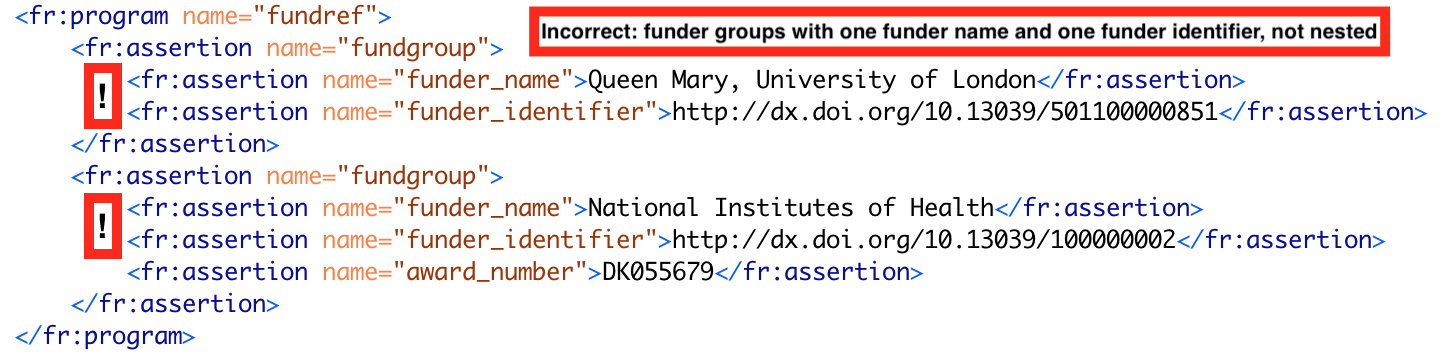
Correct nesting of funder names and identifiers is essential as it significantly impacts how funders, funder identifiers, and award numbers are related to each other.
Award and grant information:
You should include a grant DOI and/or an award number in your funding metadata wherever possible - the grant DOI is recommended as it is a persistent identifier.
Supplying Crossref grant DOIs will connect funding data with our Grant Linking System.
When a grant DOI is included in funding data with the grant_doi attribute, a relationship (isFinancedBy) is automatically inserted into your metadata record. If the grant DOI is registered with Crossref, the relationship will be inserted into the grant record metadata as well.
Funding data structure
Funding data is supported in schema version 4.3.0 and up and has its own namespace (fr). The fundref namespace (xmlns:fr=https://www-crossref-org.turing.library.northwestern.edu/fundref.xsd) must be included in the schema declaration:
Funding data consists of a series of nested <fr:assertion> tags with enumerated name attributes. The name attributes are:
fundgroup: used to group a funder and its associated award number(s) for items with multiple funders.
funder_name: name of the funding agency as it appears in the Funder Registry. Funder names that do not match those in the registry will be accepted to cover instances where the funding organisation is not listed.
ror: identifier of the funding agency as it appears in the Research Organisation Registry (ROR).
award_number: grant number or other fund identifier.
grant_doi: Crossref grant ID or other grant DOI, may be provided as a DOI or prefixed with https://doi-org.turing.library.northwestern.edu/.
In addition to a funder_name, a ror or funder_identifier must be included for the funding data to be included in REST API filters and facets. Multiple funder_name, funder_identifier / ror, and award_number / grant_doi assertions may be included. Deposits with only an award_number assertion are not allowed.
Some rules will be enforced by the deposit logic instead of the XML schema, including:
Nesting of <fr:assertion> elements: the schema allows infinite nesting of the assertion element to accommodate nesting of an element within itself. Deposit code will only allow 3 levels of nesting (with attribute values of fundgroup, funder_name, and funder_identifier).
Values of different <fr:assertion> elements: funder_name, funder_identifier, ror,award_number and grant_doi have additional validation rules imposed:
funder_identifier and grant_doi are DOIs and must follow the basic DOI format: 10.xxxx/(doi suffix) or https://doi-org.turing.library.northwestern.edu/10.xxxx/(doi suffix).
Only valid funder identifiers will be accepted: the funder_identifier value will be compared against the Open Funder Registry. If the funder_identifier is not found, the deposit will be rejected.
Funder and award number hierarchy
A relationship between a single funder and award_number or grant_doi is established by including assertions with a <fr:program>.
In this example, a single funder (National Institute on Drug Abuse with ROR ID https://ror.org/00fq5cm18) is associated with award number JQY0937263:
<fr:programname="fundref"><fr:assertionname="funder_name">US Department of Energy
<fr:assertionname="funder_identifier">https://doi-org.turing.library.northwestern.edu/10.13039/100000015</fr:assertion></fr:assertion><fr:assertionname="grant_doi">10.46936/aps-182101/60010611</fr:assertion></fr:program>
If multiple funder and award combinations exist, each combination should be deposited within a fundgroup to ensure that the award number is associated with the appropriate funder(s). In this example, two groups exist:
Funder National Science Foundation with ROR ID https://ror.org/021nxhr62 is associated with award numbers CBET-106 and CBET-106, and
<fr:programname="fundref"><fr:assertionname="fundgroup"><fr:assertionname="ror">https://ror.org/021nxhr62</fr:assertion><fr:assertionname="award_number">CBET-106</fr:assertion><fr:assertionname="award_number">CBET-7259</fr:assertion></fr:assertion><fr:assertionname="fundgroup"><fr:assertionname="funder_name">Basic Energy Sciences, Office of Science, U.S. Department of Energy
<fr:assertionname="funder_identifier">https://doi-org.turing.library.northwestern.edu/10.13039/100006151</fr:assertion></fr:assertion><fr:assertionname="grant_doi">10.46936/rapd.proj.2016.49526/60006021</fr:assertion></fr:assertion></fr:program>
Nesting of names
An Open Funder Registry identifier may be provided alone or with a funder name. To associate a name with an identifier, the identifier must be nested within the funder_name assertion. If not nested, the name and identifier will be treated as two separate funders.
<fr:assertionname="funder_name">National Science Foundation
<fr:assertionname="funder_identifier">https://doi-org.turing.library.northwestern.edu/10.13039/100000001</fr:assertion></fr:assertion>
In this example, funder National Science Foundation is only identified by name. This submission will be successful but will not be included in REST API filters or the Open Funder Registry search unless the name provided can be matched with a funder identifier:
Award numbers (award_number) and grant DOIs (grant_doi) may be provided alone or in combination. A grant DOI is sufficient to identify an individual grant but an award number may be supplied as well provided the award number is nested within the grant_doi assertion.
Here, the award number ABC-123 is nested within grant DOI 10.32013/501100002241:
<fr:programname="fundref"xmlns:fr="http://www.crossref.org.turing.library.northwestern.edu/fundref.xsd"><fr:assertionname="funder_name">American Academy of Clinical Toxicology
<fr:assertionname="funder_identifier">https://doi-org.turing.library.northwestern.edu/10.13039/100009524</fr:assertion></fr:assertion><fr:assertionname="grant_doi">10.32013/501100002241
<fr:assertionname="award_number">ABC-123</fr:assertion></fr:assertion></fr:program>
Relationships and grant DOIs
When a grant DOI is included in a grant_doi assertion, relationship metadata is automatically inserted into the XML and JSON metadata record of the item being registered or updated.
In the XML, the grant DOI is included in UNIXSD outputs as a crm-item:
<doitype="journal_article">10.32013/0pZYqjcXd4m</doi><crm-itemname="publisher-name"type="string">Society of Psychoceramics</crm-item><crm-itemname="prefix-name"type="string">Society of Psychoceramics</crm-item><crm-itemname="member-id"type="number">17333</crm-item><crm-itemname="citation-id"type="number">168234014</crm-item><crm-itemname="journal-id"type="number">458334</crm-item><crm-itemname="deposit-timestamp"type="number">22025013010101022</crm-item><crm-itemname="owner-prefix"type="string">10.32013</crm-item><crm-itemname="last-update"type="date">2026-02-18T14:01:27Z</crm-item><crm-itemname="created"type="date">2024-12-03T11:34:11Z</crm-item><crm-itemname="citedby-count"type="number">0</crm-item><crm-itemname="relation"type="doi"claim="isFinancedBy">10.32013/vGVkUKI</crm-item>
This allows the relationship(s) to be inserted into JSON outputs:
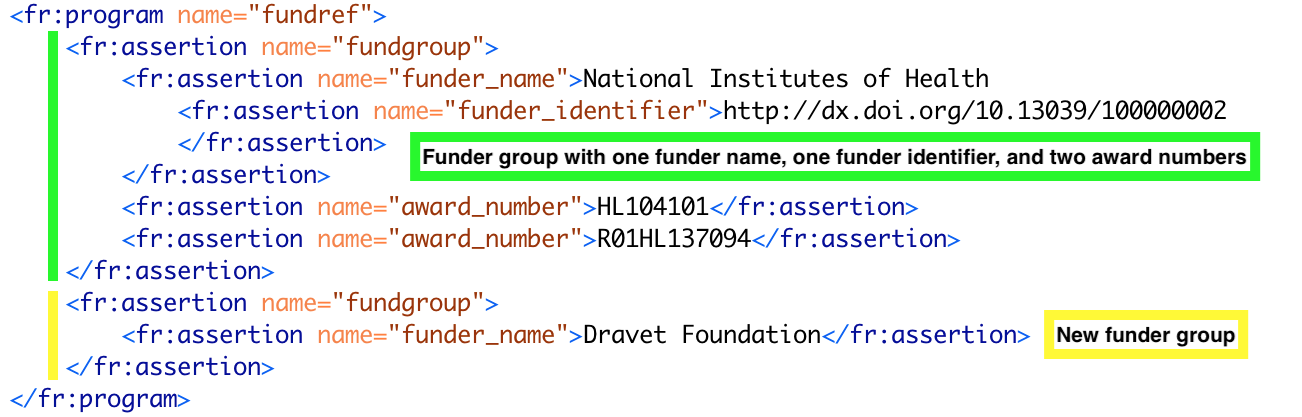
fundgroup assertions are used to group different funder and award combinations. When contained within a single fundgroup, all funder name/ID combinations and awards (funder-specific awards or Grant DOIs) within the fundgroup will be associated together.
In the example below, funder National Institutes of Health is the funder of awards HL104101 and RO1HL137094. Dravet Foundation is in a distinct fundgroup and will not be associated with items in the first fundgroup.
Funding metadata can be deposited with Crossref in two ways:
In a stand-alone deposit where just the funding metadata is provided.
As part of the full set of metadata for an article.
When funding data is successfully deposited, an inserted identifier will appear as a message (<msg>) within the submission log:
<record_diagnosticstatus="Success"><doi>10.1016/j.apcatb.2018.04.081</doi><msg>Inserted identifier: 501100001809 for name: "the National Natural Science Foundation of China"
</msg>
Resource deposit
Resource deposits may be used to append or replace funding data for an existing metadata record. The deposit XML file contains just the DOI of the article and the specific funding data. Please note the following:
If the DOI record currently has any funding data it will be fully overwritten by the new data.
If the DOI currently has any Crossmark data, the new funding data will be inserted within the existing (previously deposited) Crossmark data.
Funding data may be deposited as part of a normal ‘full’ metadata XML deposit for a DOI.
<?xml version="1.0" encoding="UTF-8"?><doi_batchversion="4.4.0"xmlns="http://www.crossref.org.turing.library.northwestern.edu/schema/4.4.0"xmlns:xsi="http://www.w3.org/2001/XMLSchema-instance"xsi:schemaLocation="http://www.crossref.org.turing.library.northwestern.edu/schema/4.4.0 http://www.crossref.org.turing.library.northwestern.edu/schema/deposit/crossref4.4.0.xsd"xmlns:fr="http://www.crossref.org.turing.library.northwestern.edu/fundref.xsd"><head><doi_batch_id>7ce0adc7155c63a5e2b-3ebc</doi_batch_id><timestamp>201610241300</timestamp><depositor><depositor_name>Crossref Support</depositor_name><email_address>support@crossref.org</email_address></depositor><registrant>Crossref</registrant></head><body><journal><journal_metadatalanguage="en"><full_title>Applied Physics Letters</full_title><abbrev_title>Appl. Phys. Lett.</abbrev_title><issnmedia_type="print">00036951</issn><coden>APPLAB</coden></journal_metadata><journal_issue><publication_datemedia_type="print"><month>09</month><day>10</day><year>2012</year></publication_date><journal_volume><volume>101</volume></journal_volume><issue>11</issue></journal_issue><journal_articlepublication_type="full_text"><titles><title>Total energy loss to fast ablator-ions and target capacitance of direct-drive implosions on OMEGA</title></titles><contributors><person_namesequence="first"contributor_role="author"><given_name>N.</given_name><surname>Sinenian</surname></person_name><person_namesequence="additional"contributor_role="author"><given_name>A. B.</given_name><surname>Zylstra</surname></person_name></contributors><publication_datemedia_type="online"><month>09</month><day>10</day><year>2012</year></publication_date><pages><first_page>114102</first_page></pages><programxmlns="http://www.crossref.org.turing.library.northwestern.edu/fundref.xsd"><assertionname="ror">https://ror.org/021nxhr62</assertion><assertionname="grant_doi">10.46936/aps-182101/60010611</assertion></program><doi_data><doi>10.1063/1.4752012</doi><timestamp>20130806074500</timestamp><resource>http://scitation.aip.org.turing.library.northwestern.edu/content/aip/journal/apl/101/11/10.1063/1.4752012
</resource></doi_data></journal_article></journal></body></doi_batch>
Updating or removing funding metadata
If funding metadata is incorrect or out-of-date, it may be updated by redepositing the funding metadata. Be sure to redeposit all available metadata for an item, not just the elements being updated. A DOI may be updated without resubmitting funding metadata, as previously deposited funding metadata will remain associated with the DOI.
Funding metadata may be deleted by redepositing an item with an empty <fr:program name="fundref"> element: