We are pleased to announce that—effective 1st January 2026—we have made two changes to grant record registration fees that aim to accelerate adoption of Crossref’s Grant Linking System (GLS) and provide a two-year window of opportunity to increase the number and availability of open persistent grant identifiers and boost the matching of relationships with research objects.
We are very pleased to kick off the New Year with another important schema update and the news that a Grant DOI field is now supported for all record types. This means that Crossref members can explicitly include the Crossref Grant IDs as part of their DOI metadata records for publications and any other output type, accurately linking research outputs to the funding that made it possible, all through metadata. We hope that our members will leverage this to respond to recent calls for stronger funding transparency and best practices for reporting funding sources in research outputs.Â
As we finish celebrating our 25th anniversary, we can look back on a truly transformational year, defined by the successful delivery of several long-planned, foundational projects—as well as updates to our teams, services, and fees—that position Crossref for success over the next quarter century as essential open scholarly infrastructure. In our update at the end of 2024, we highlighted that we had restructured our leadership team and paused some projects. The changes made in 2024 positioned us for a year of getting things done in 2025. We launched cross-functional programs, modernised our systems, strengthened connections with our growing global community, and streamlined a bunch of technical and business operations while continuing to grow our staff, members, content, relationships, and community connections.
Crossref turned twenty-five this year, and our 2025 Annual Meeting became more than a celebration—it was a shared moment to reflect on how far open scholarly infrastructure has come and where we, as a community, are heading next.
Over two days in October, hundreds of participants joined online and in local satellite meetings in Madrid, Nairobi, Medan, Bogotá, Washington D.C., and London––a reminder that our community spans the globe. The meetings offered updates, community highlights, and a look at what’s ahead for our shared metadata network––including plans to connect funders, platforms, and AI tools across the global research ecosystem.
The field or missing metadata report gives details on metadata completeness and can be accessed by selecting the icon next to each member name in the depositor report (access the depositor reports by type at the links below). The fields checked are volume, issue, page, author, article title, and Similarity Check URL.
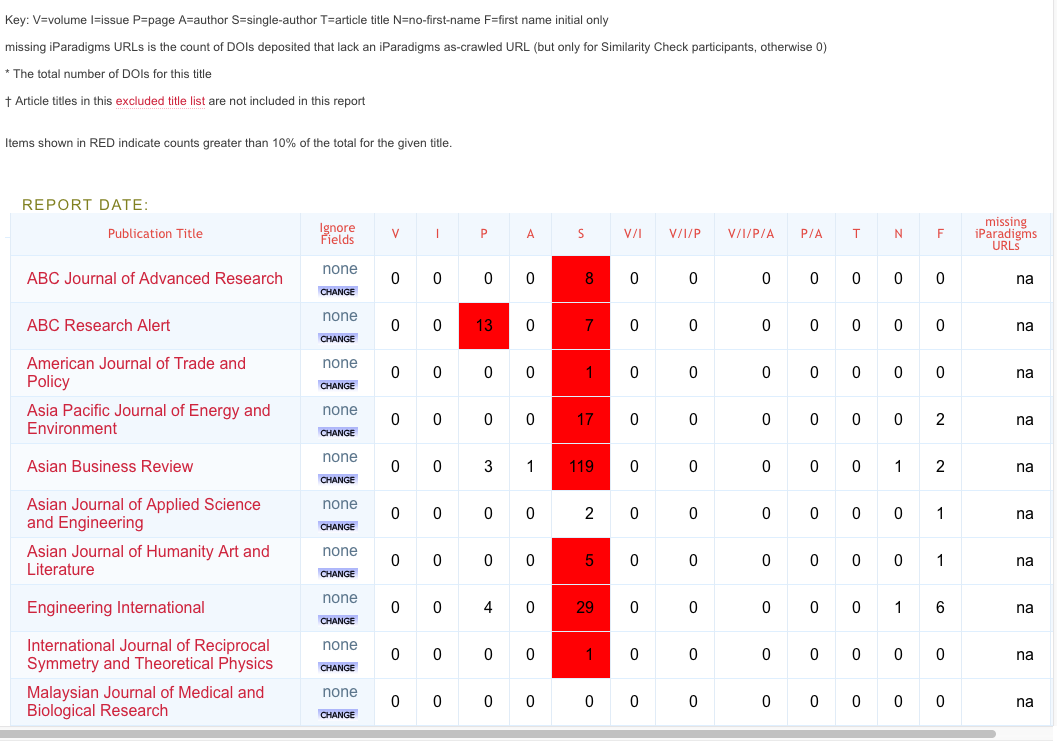
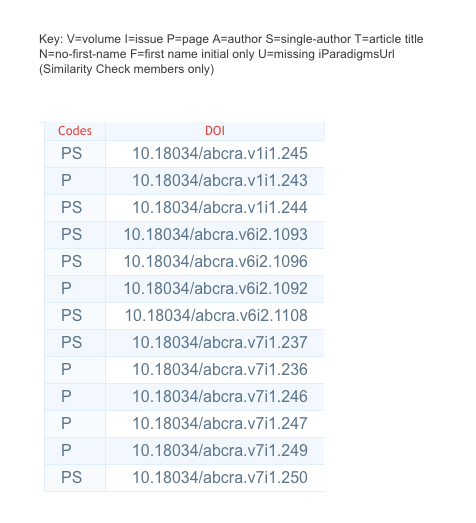
Select a title to retrieve a list of DOIs for the title, and flagged fields for each DOI. For example, the DOIs in this report lack page and author information:
Although the deposit section of the schema specifies that some bibliographic metadata is optional for content registration purposes, we strongly encourage members to register comprehensive metadata for each item registered.
Page maintainer: Isaac Farley Last updated: 2024-July-19