On behalf of the Nominating Committee, I’m pleased to share the slate of candidates for the 2026 board election. Every active member organisation is invited to submit a ballot to elect the incoming board class.
We’re providing a summary of the board’s July 2026 meeting. The July board meeting is our only in-person meeting. The board gathers for two days of strategic thinking and long-range planning, as well as conducting annual board business. This year, we focused on allocating surplus funds we have on hand to invest in a three-year project to redesign the content system. In a related discussion, we decided to lower content registration fees starting in 2027 because we’ve had a demonstrated history of generating surpluses, exceeding what we need to run Crossref. We also discussed the board structure, as part of our regular review of stakeholder governance. And we conducted annual board business, such as approving the audited financial statements and reviewed our risk register and mitigation plans.
The resolutions are available on the dedicated section of our website, which also lists the members of the Board and offers further information about our governance.
We also managed to squeeze in watching a World Cup game over dinner.
Starting today, funder names deposited in Crossref metadata without an identifier will be matched to ROR IDs, to support an open and connected Research Nexus. Funding information is an increasingly important part of the scholarly record. The improved matching strategy supports researchers, funders, institutions, and meta-researchers, who rely on that information to understand how research is supported and what outcomes that support produces.
Strengthening Scholarly Publishing in Africa is a collaborative webinar series bringing together ASSAf, Crossref, DOAJ, EIFL, and PKP to share practical guidance, resources, and approaches for strengthening the publishing ecosystem in the region. This series responds to the growing interest in open access, digital publishing, stronger editorial practices, and greater visibility of research publishing across Africa. Each partner organisation has long experience of building that capacity in the area of their expertise. In this series, we’re coming together to offer a more holistic learning experience to the community of African publishers, putting different aspects of the publishing process in their broader context.
Version control is the management of changes to a document, file, or dataset. Versions of a document may include the following:
Draft
Preprint - early draft or manuscript shared by researcher in a preprint repository or dedicated channel (outside of a specific journal)
Pending publication (PP) - a manuscript which has been accepted but has not yet been published online
Advanced online publication or ahead of print (AOP) - early release of publication which publisher makes available to readers on their platform (prior to typesetting or before final published form)
Author accepted manuscript (AAM) - accepted version which has been peer reviewed but not typeset or copyedited
Version of record (VoR) - typeset, copyedited, and published version
Updated - adding supplementary data or making corrections to the file, or its retraction.
Version control is important for:
traceability (following the development of the document),
identifiability (connecting documents to decisions, contributions, contributors, and time),
clarity (distinguishing between multiple versions of documents, and identifying the latest version),
reduced duplication (removing out-of-date versions), and
reduced errors (clearly indicating to readers which is the current version).
Publication stages and DOIs
How do I decide if I should assign a DOI to a work, and at what stage? This table sets out seven publication stages of a research object (a publication such as a journal article, book, or dataset). A work may not go through all of these seven stages, so you only need to consider the stages relevant to your publication.
Publication stage
Eligible for a DOI?
Which DOI?
1 Draft
No DOI for draft item
n/a
2 Preprint
Yes
DOI A
3 Pending publication (PP)
Yes
DOI B
4 Advanced online publication/ahead of print (AOP)
Yes
DOI B
5 Author accepted manuscript (AAM)
Yes
DOI B
6 Version of record (VoR)
Yes
DOI B
7 Updated
Yes
DOI C
A DOI should not be assigned to a draft (unpublished) work.
A preprint should have its own DOI (DOI A).
Accepted versions (including PP, AOP, AAM, and VoR) should have a separate DOI (DOI B). Establish a relationship between DOI B and DOI A to show the connection between them, such as DOI B “hasPreprint” DOI A.
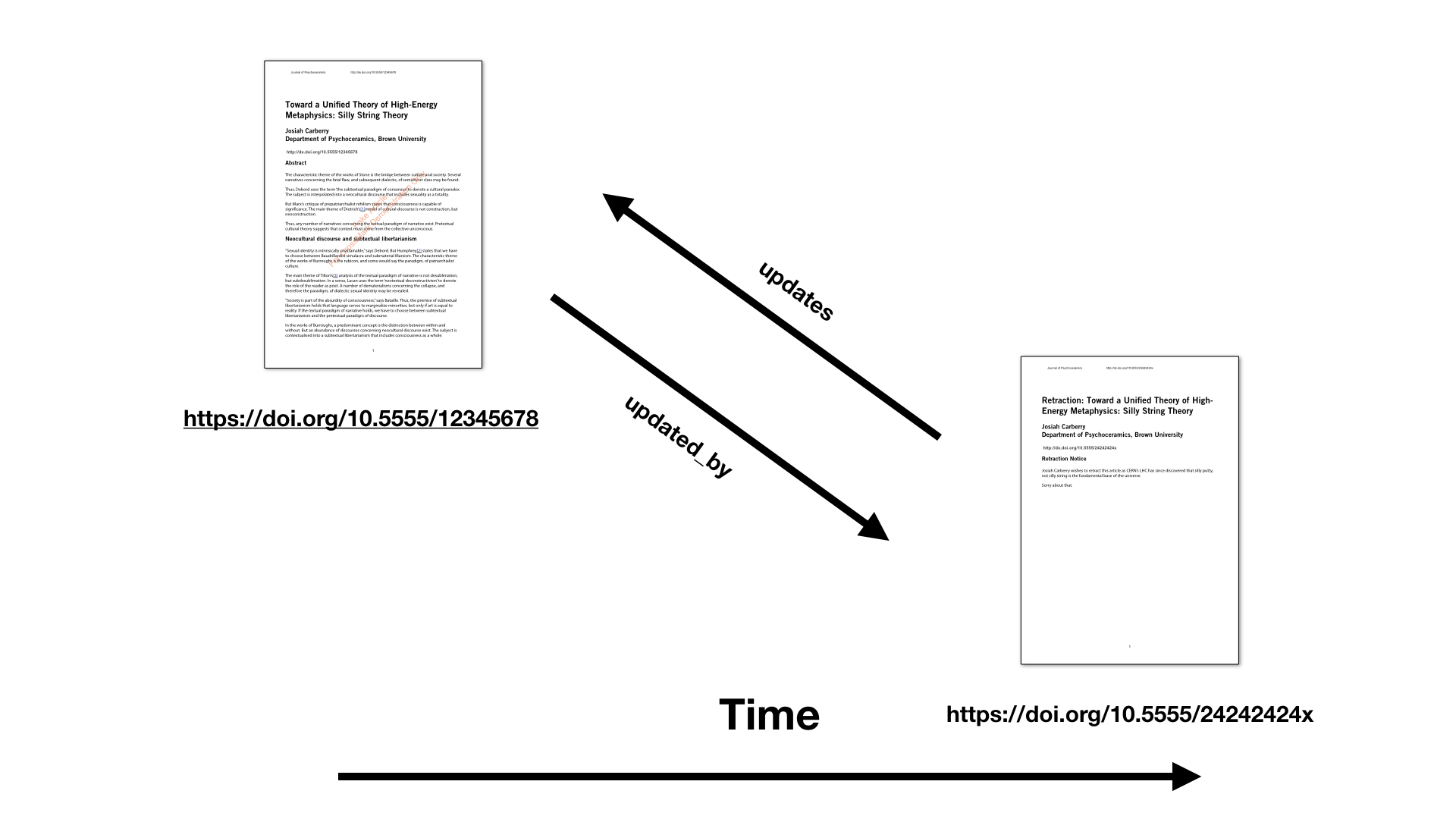
In the case of a significant change to the published version, a notice should be published explaining the correction/update/retraction. The updated version should have a new DOI (DOI C). Updates should only be deposited for changes that are likely to affect the interpretation or crediting of the work (editorially significant changes), and instead of simply asserting a relationship, these should be recorded as updates. See the following section for more information on updates.
Best practices for handling retractions and other post-publication updates
Research can undergo changes after it is published for various reasons. For example, it may be withdrawn, corrected, or retracted. It’s important that these changes are accurately reflected in the scholarly record, so that readers know how to find the most up-to-date work, as well as what research can be relied upon and cited.
When an editorially significant update is made to a document, you should not modify the original document, but instead issue a separate document (such as a correction or retraction notice) which explains the change. This separate document will have a different DOI and different metadata from the document that it updates. This process is complementary to versioning.
The metadata for the update should include a link to the item being updated, as well as information on the type of update, as part of the Crossmark section of the metadata:
A full example of an XML file following best practice can be found here. If you are not comfortable editing XML, you can also register DOI records for post-publication updates (such as retraction notices) in the new Metadata Manager tool, or deposit Crossmark metadata in the Web Deposit Form.
Note that you don’t need to use all aspects of Crossmark to register updates. Learn more about the different ways of registering updates in our documentation.
You should also reflect the status of the work in the original DOI’s metadata record by adding “RETRACTED:” in front of the article title. We recommend doing the same for the title listed on the item’s landing page. You may also want to replace the abstract of the work with a retraction statement in both the metadata and on your website or publishing platform.
Finally, if you participate in the Similarity Check service, you should remove the full-text URL from the item’s metadata. To get a retracted work to be removed from the Similarity Check text comparison database, get in touch with Turnitin at tiisupport@turnitin.com.