Crossref members register around 37,000 records daily. All this metadata is openly shared with the global scholarly community through our free APIs. We receive over two billion calls to our API each month, signalling its use by hundreds of tools and services worldwide, supporting the discovery and assessment of scholarly metadata. As part of a new series in our blog, we will spotlight the diversity of tools and integrations that rely on Crossref metadata to serve the scholarly community. In this initial post, we chat to Luca Foppiano, the developer and maintainer of Grobid1, to learn about how Grobid uses Crossref metadata to improve the extraction and enrichment of bibliographic information from scholarly PDFs.
On behalf of the Nominating Committee, I’m pleased to share the slate of candidates for the 2026 board election. Every active member organisation is invited to submit a ballot to elect the incoming board class.
We’re providing a summary of the board’s July 2026 meeting. The July board meeting is our only in-person meeting. The board gathers for two days of strategic thinking and long-range planning, as well as conducting annual board business. This year, we focused on allocating surplus funds we have on hand to invest in a three-year project to redesign the content system. In a related discussion, we decided to lower content registration fees starting in 2027 because we’ve had a demonstrated history of generating surpluses, exceeding what we need to run Crossref. We also discussed the board structure, as part of our regular review of stakeholder governance. And we conducted annual board business, such as approving the audited financial statements and reviewed our risk register and mitigation plans.
The resolutions are available on the dedicated section of our website, which also lists the members of the Board and offers further information about our governance.
We also managed to squeeze in watching a World Cup game over dinner.
Starting today, funder names deposited in Crossref metadata without an identifier will be matched to ROR IDs, to support an open and connected Research Nexus. Funding information is an increasingly important part of the scholarly record. The improved matching strategy supports researchers, funders, institutions, and meta-researchers, who rely on that information to understand how research is supported and what outcomes that support produces.
The Open Funder Registry (OFR, formerly FundRef) and associated funding metadata allows everyone to have transparency into research funding and its outcomes. It’s an open and unique registry of persistent identifiers for grant-giving organisations around the world.
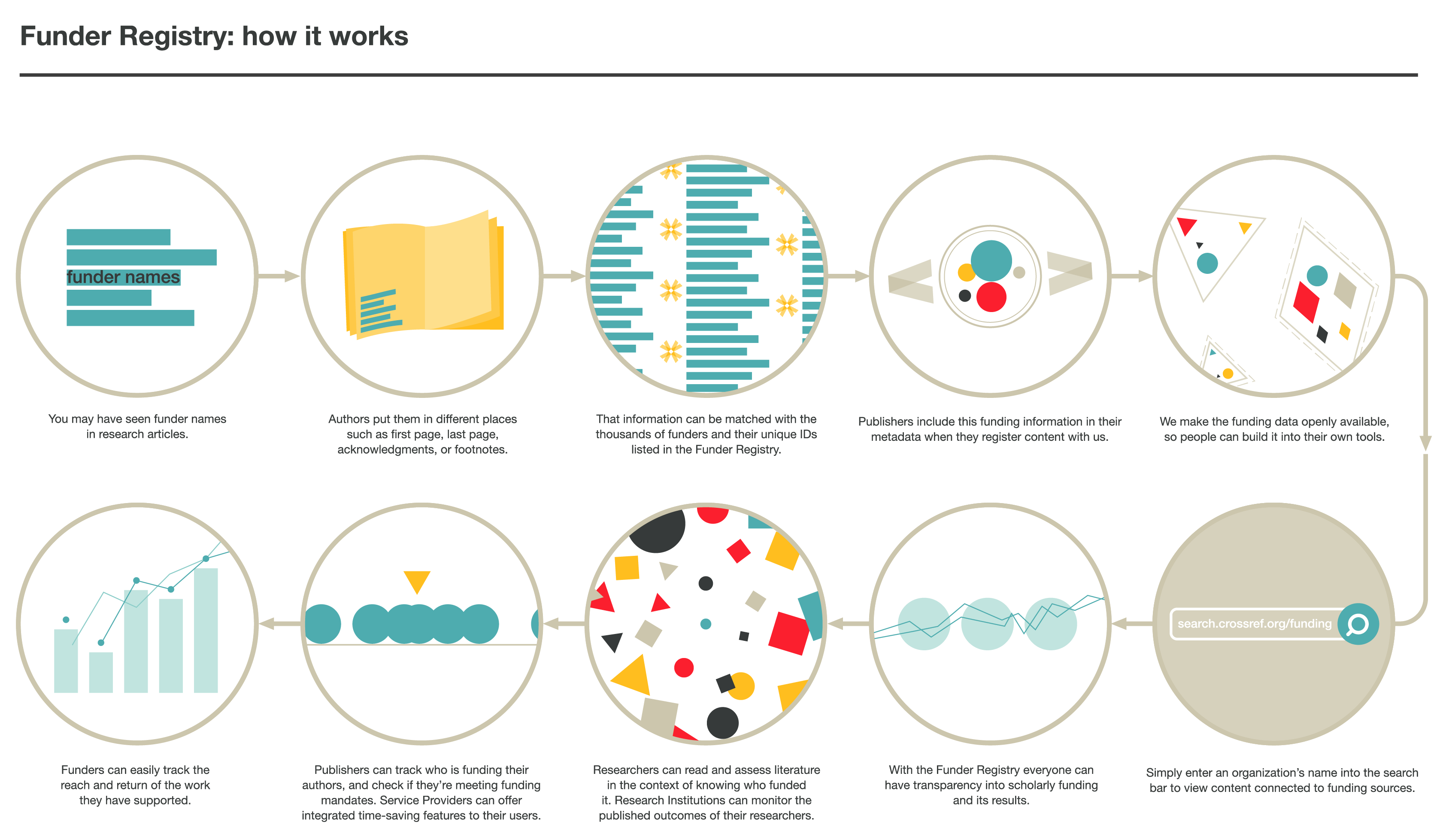
It is good practice for authors to acknowledge support for and contributions to their research in their published articles. This support may be financial, such as a grant or salary award; or practical, such as the use or loan of specialist facilities and equipment. They do this by listing the funding agency and the grant number somewhere in their article - usually the first or last page, or in the acknowledgments or footnotes section. Members contribute by depositing the funding acknowledgements from their publications as part of their standard metadata, together with the unique funder IDs listed in the OFR. The deposit should include funder names, funder IDs, and associated grant numbers.
This means that anyone can make connections, for example, to identify which funders invest in certain fields of research. Funding data is also used by funders to track the publications that result from their grants.
The Crossref OFR is an open registry of grant-giving organisation names and identifiers, which you use to find funder IDs and include them as part of your metadata deposits. It is a freely-downloadable RDF file. It is CC0-licensed and available to integrate with your own systems. Funder names from acknowledgements should be matched with the corresponding unique funder ID from the registry.
You can search funding metadata manually using our funding data search, or programmatically via our REST API. This data not only clarifies the scholarly record, but makes life easier for researchers who may need to comply with requirements to make their published results publicly available.
Watch the introductory Open Funder Registry animation in your language:
There are many benefits of clear, transparent, and measurable information on who funded research, and where it has been published. The OFR facilitates accurate funding metadata, which in turn enables multiple parties to better understand the research funding landscape:
Readers and researchers can read and assess literature in the context of knowing who funded it;
Research institutions can monitor the published outputs of their researchers;
Publishers can track who is funding their authors, and check if they’re meeting funding mandates;
Service providers can offer integrated time-saving features to their users; and
Funders can easily track the reach and return of the work they have supported.
The registry is donated by Elsevier, and is updated around every 4-6 weeks with new and updated funder records. Existing entries are also reviewed to make sure that they are accurate and up-to-date. We can then make it openly available through our funding data search and our API. If you spot anything that doesn’t look right, please let us know. You can also download a .csv file of the latest registry.
Using the OFR, members can find the unique IDs for these funders, standardize this metadata to send it to us.
Obligations and fees for the Open Funder Registry
The OFR is open to everyone. There are no fees for members depositing funding data. Open Funder Registry search and our API are also freely available.
Members must include the OFR ID for each funder if it is present in the Registry. If a funder is not in the Registry and does not have an ID, include the name of the funder.
How to participate in the Open Funder Registry
To access the OFR, you do not need to be a member, but you need to be a member to include OFR IDs in your Crossref metadata. Anyone who’s interested can simply enter an organisation’s name into the Open Funder Registry search to view content connected to funding sources. The metadata in the registry is also openly available via our API, and as a downloadable RDF file. Learn more about accessing the OFR.
Depositing metadata (members): collect funder names and grant numbers from your authors through your manuscript tracking system (or extract them from acknowledgements sections) and match them with the corresponding Funder IDs from the registry. Once this is done, it’s easy to add these three additional pieces of metadata - funder name, funder id, and grant number - as additional metadata in the regular Crossref content registration service. Learn more about how to collect and register funding data.
Whenever you register content with us, make sure you include funder names and grant numbers in the submission:
If you’re depositing XML with Crossref, include your funding data in your XML.
Retrieving metadata: you can view the content that has cited a particular funding source by entering the organisation’s name into the Open Funder Registry search. If you prefer a machine-readable query, use our REST API. If you have questions about how your organisation appears in the registry then please get in touch. Learn more about the OFR and our other services on our funder community page.