On behalf of the Nominating Committee, I’m pleased to share the slate of candidates for the 2026 board election. Every active member organisation is invited to submit a ballot to elect the incoming board class.
We’re providing a summary of the board’s July 2026 meeting. The July board meeting is our only in-person meeting. The board gathers for two days of strategic thinking and long-range planning, as well as conducting annual board business. This year, we focused on allocating surplus funds we have on hand to invest in a three-year project to redesign the content system. In a related discussion, we decided to lower content registration fees starting in 2027 because we’ve had a demonstrated history of generating surpluses, exceeding what we need to run Crossref. We also discussed the board structure, as part of our regular review of stakeholder governance. And we conducted annual board business, such as approving the audited financial statements and reviewed our risk register and mitigation plans.
The resolutions are available on the dedicated section of our website, which also lists the members of the Board and offers further information about our governance.
We also managed to squeeze in watching a World Cup game over dinner.
Starting today, funder names deposited in Crossref metadata without an identifier will be matched to ROR IDs, to support an open and connected Research Nexus. Funding information is an increasingly important part of the scholarly record. The improved matching strategy supports researchers, funders, institutions, and meta-researchers, who rely on that information to understand how research is supported and what outcomes that support produces.
Strengthening Scholarly Publishing in Africa is a collaborative webinar series bringing together ASSAf, Crossref, DOAJ, EIFL, and PKP to share practical guidance, resources, and approaches for strengthening the publishing ecosystem in the region. This series responds to the growing interest in open access, digital publishing, stronger editorial practices, and greater visibility of research publishing across Africa. Each partner organisation has long experience of building that capacity in the area of their expertise. In this series, we’re coming together to offer a more holistic learning experience to the community of African publishers, putting different aspects of the publishing process in their broader context.
We’ve had a year full of growth and reached a milestone of 60+ team members; let’s take a moment to digest what that means for people operations. Hiring staff in 19+ countries is no easy task, but we are up for it, and I can honestly say it is the main reason why our culture is so great. That might sound biased coming from Crossref’s first Head of Human Resources, but hear me out.
As Crossref membership continues to grow, finding ways to help organisations participate is an important part of our mission. Although Crossref membership is open to all organisations that produce scholarly and professional materials, cost and technical challenges can be barriers to joining for many.
Sponsors make Crossref membership accessible to organisations that would otherwise face barriers to joining us. They also provide support to facilitate participation, which increases the amount and diversity of metadata in the global Research Nexus. This in turn improves discoverability and transparency of scholarship behind the works.
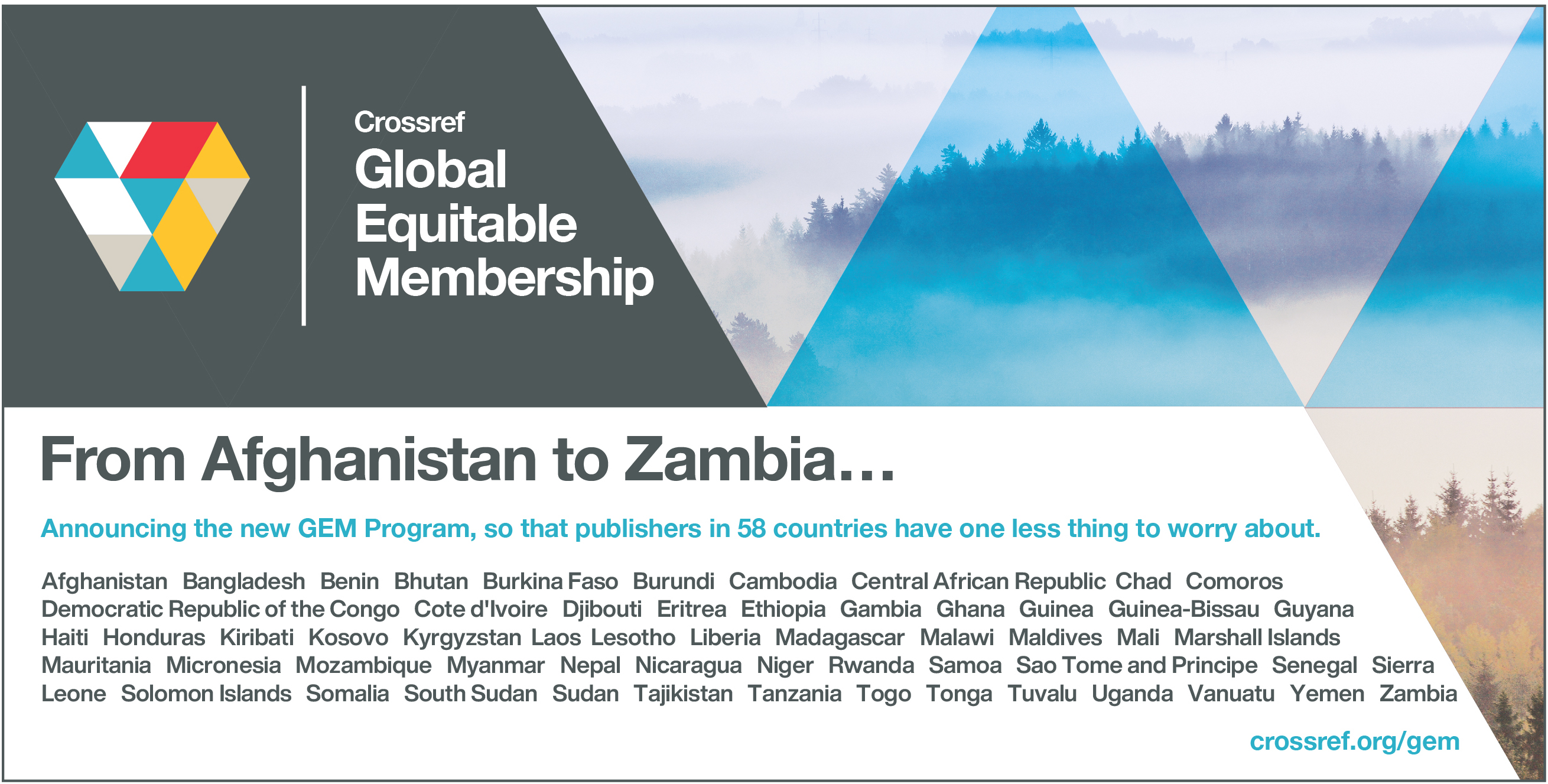
We began our Global Equitable Membership (GEM) Program to provide greater membership equitability and accessibility to organisations in the world’s least economically advantaged countries. Eligibility for the program is based on a member’s country; our list of countries is predominantly based on the International Development Association (IDA). Eligible members pay no membership or content registration fees. The list undergoes periodic reviews, as countries may be added or removed over time as economic situations change.
In January 2023, we began our Global Equitable Membership (GEM) Program to provide greater membership equitability and accessibility to organisations located in the least economically advantaged countries in the world. Eligibility for the program is based on a member’s country; our list of countries is predominantly based on the International Development Association (IDA). Eligible members pay no membership or content registration fees.
The list undergoes periodic reviews, as countries may be added or removed over time as economic situations change. Sri Lanka was added to the GEM program in March 2023 as they were recategorised to the IDA classification by the World Bank.
Some small organisations who want to register metadata for their research and participate in Crossref are not able to do so due to financial, technical, or language barriers. To attempt to reduce these barriers we have developed several programs to help facilitate membership. One of the most significant—and successful—has been our Sponsor program.
Sponsors are organisations that are generally not producing scholarly content themselves but work with or publish on behalf of groups of smaller organisations that wish to join Crossref but face barriers to do so independently. Sponsors work directly with Crossref in order to provide billing, technical, and, if applicable, language support to Members.
When Crossref began over 20 years ago, our members were primarily from the United States and Western Europe, but for several years our membership has been more global and diverse, growing to almost 18,000 organisations around the world, representing 148 countries.
As we continue to grow, finding ways to help organisations participate in Crossref is an important part of our mission and approach. Our goal of creating the Research Nexus—a rich and reusable open network of relationships connecting research organisations, people, things, and actions; a scholarly record that the global community can build on forever, for the benefit of society—can only be achieved by ensuring that participation in Crossref is accessible to all. Building a network for the global community must include input from all of the global community.