We’re excited to announce a new data citation API endpoint and are seeking your feedback. The new service makes existing data citation relationships in our metadata available, thereby surfacing this part of the research nexus. At the same time, we’ve decided that it’s time to move on from Event Data.
Metadata is communication; it can tell a story about research and paint a picture for others to respond to and learn from, across the world and throughout the forthcoming generations. Metadata can feel technical with words like ‘infrastructure’ and ‘schema’, and sometimes, like tech in general, it comes with hyperbole. But metadata really is part art (storytelling and pictures) and part science (structured models and standards) with both aspects being equally important, and requiring people as well as systems. That necessary combination of human and machine involvement also makes metadata challenging.
Once a year we release all metadata records for content registered with Crossref in a public data file. This year’s version, containing nearly 180 million records, is now available. It includes metadata associated with all Crossref-registered DOIs in JSON-lines format.
Crossref Ambassadors act as local points of contact, meeting editors, librarians, researchers, and institutions to help them navigate Crossref services and understand how strong metadata supports visibility, integrity, and trust in research. They explain how to participate in our rich network of connections between works, people, and institutions, in ways that make sense in their own contexts. And last year, being our 25th anniversary, Ambassadors also massively contributed to our celebrations!
It can be a pain when companies rebrand as it usually requires some coordinated updating of wording and logos on websites, handouts, and slides. Nevermind changing habits and remembering to use the new names verbally in presentations.
Why bother?
As our infrastructure and services expanded, we sometimes branded services with no reference to Crossref. As explained in our The Logo Has Landed post last November, this has led to confusion, and it was not scalable nor sustainable.
With a cohesive approach to naming and branding, the benefits of changing to (some) new names and logos should help everyone. Our aim is to stem confusion and be in a much better position to provide clear messages and useful resources so that people don’t have to try hard to understand what Crossref enables them to do.
So while it may be a bit of a pain short-term, it will be worth it!
What are the new names?
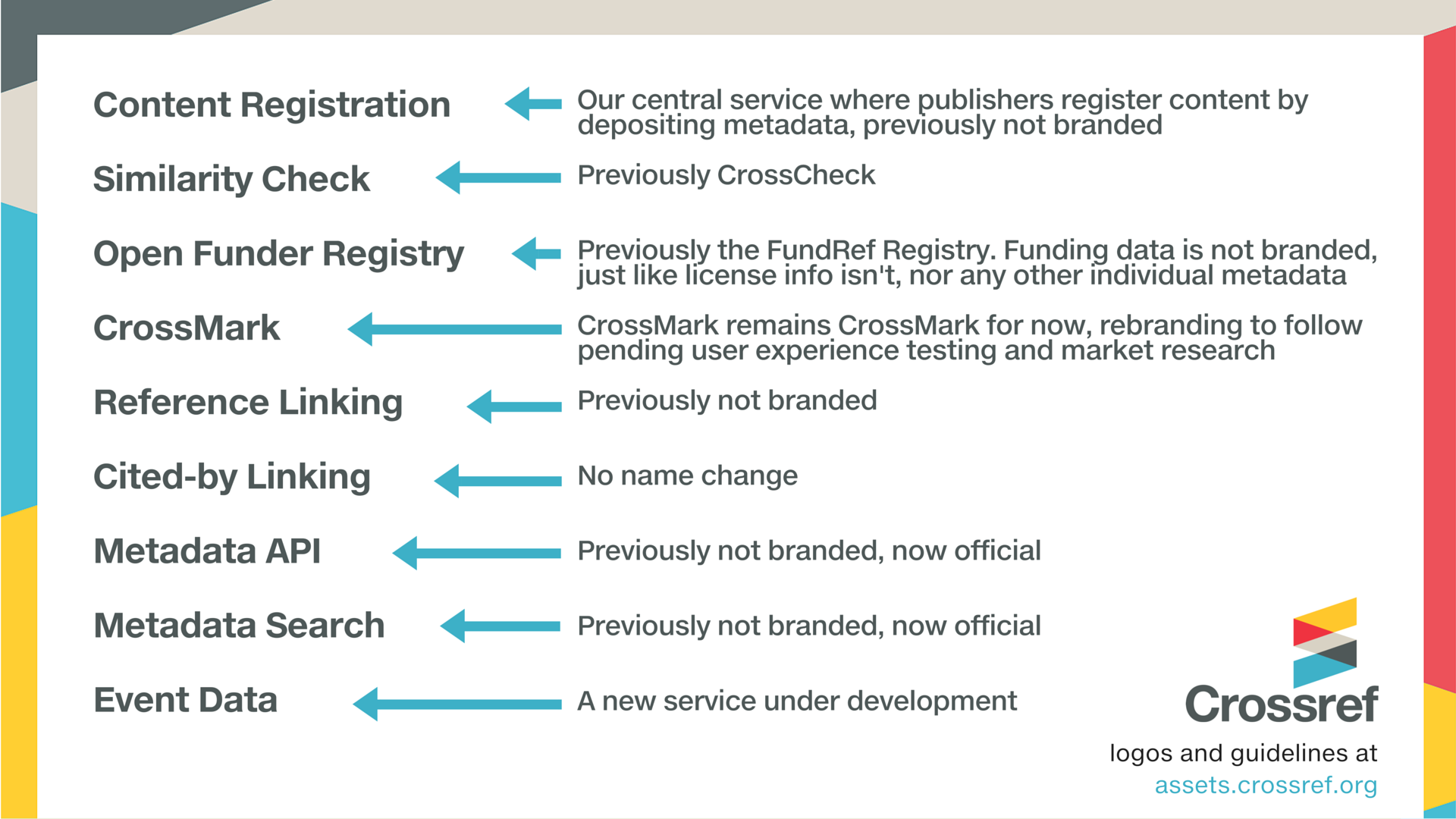
As a handy reference, here is a slide-shaped image giving an overview of our services with their new names:
Overview of brand name changes, April 2016
It’s a lowercase ‘r’ in Crossref
That’s right, you’ve spent fifteen years learning to capitalize the second R in Crossref, and now we’re asking you to lowercase it! Please say hello to and start to embrace the more natural and contemporary Crossref.
I’m hoping we can count on our community to update logos and names on your end, keeping consistent with new brand guidelines. And I hope we can make it as easy as possible to do:
This Content Delivery Network (CDN) at assets.crossref.org allows you to reference logos using a snippet of code. Please do not copy/download the logos.
We also have a new website in development which will put support and resources front and center of the user experience. More on that in the next month or two.
By using the snippets of code provided via our new CDN at assets.crossref.org, these kind of manual updates should never be a problem in the future if the logo changes again (no plans anytime soon!).
Of course, we don’t expect people to update new logos and names immediately, there is always a period of transition. Please let us know let us know if we can help you to update your sites and materials in the coming weeks.
Also, check out the launch video, which presents five key Crossref brand messages: