We’re excited to announce a new data citation API endpoint and are seeking your feedback. The new service makes existing data citation relationships in our metadata available, thereby surfacing this part of the research nexus. At the same time, we’ve decided that it’s time to move on from Event Data.
Metadata is communication; it can tell a story about research and paint a picture for others to respond to and learn from, across the world and throughout the forthcoming generations. Metadata can feel technical with words like ‘infrastructure’ and ‘schema’, and sometimes, like tech in general, it comes with hyperbole. But metadata really is part art (storytelling and pictures) and part science (structured models and standards) with both aspects being equally important, and requiring people as well as systems. That necessary combination of human and machine involvement also makes metadata challenging.
Once a year we release all metadata records for content registered with Crossref in a public data file. This year’s version, containing nearly 180 million records, is now available. It includes metadata associated with all Crossref-registered DOIs in JSON-lines format.
Crossref Ambassadors act as local points of contact, meeting editors, librarians, researchers, and institutions to help them navigate Crossref services and understand how strong metadata supports visibility, integrity, and trust in research. They explain how to participate in our rich network of connections between works, people, and institutions, in ways that make sense in their own contexts. And last year, being our 25th anniversary, Ambassadors also massively contributed to our celebrations!
Tl;dr: Metadata for the (currently 26,000) grants that have been registered by our funder members is now available via the REST API. This is quite a milestone in our program to include funding in Crossref infrastructure and a step forward in our mission to connect all.the.things. This post gives you all the queries you might need to satisfy your curiosity and start to see what’s possible with deeper analysis. So have the look and see what useful things you can discover.
Since late 2019, research funders have been registering metadata and identifiers for their grants with us. We currently have a healthy 26k grants registered with us, via 13 funding organisations. I’d specifically highlight Wellcome for volume (registering via Europe PMC), and the Australian Research Data Commons (ARDC) who was the first funder that included ROR IDs in their grant metadata, really getting the value of connecting all related entities and contributors.
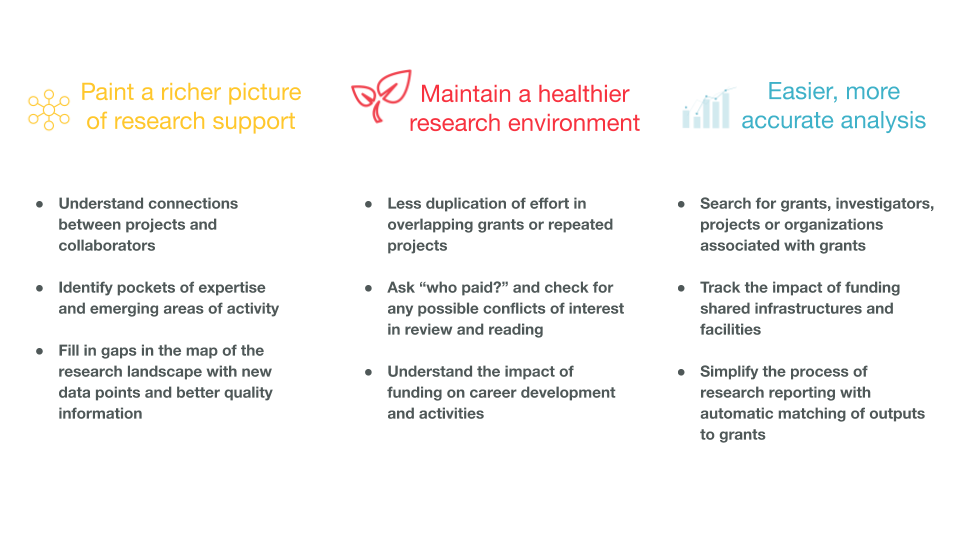
The reasons for registering grants with Crossref? Let’s recap:
Support of open data and information about grants
Streamlined discovery of funded content
Improved analytics and data quality
More complete picture of outputs and impact
Better value from investments in reporting services
Improved timeliness, completeness and accuracy of reporting: save time for researchers
More complete information to support analysis and evaluation without relying on manual data entry
How it’s going
For grant information to be used, it’s key that it is is openly available and disseminated as widely as possible. That work starts with funders registering their grants, and continues with us. Now that we’ve completed the REST API’s Elasticsearch migration, we’re happy to announce that all our grant information is now available via our REST API.
"publisher":"Wellcome","award":"107769","DOI":"10.35802/107769","type":"grant","created":{"date-parts":[[2019,9,25]],"date-time":"2019-09-25T07:17:20Z","timestamp":1569395840000},"source":"Crossref","prefix":"10.35802","member":"13928","project":[{"project-title":[{"title":"Initiative to Develop African Research Leaders (IDeAL)"}],"project-description":[{"description":"Research is key in tackling the heath challenges that Africa faces. In KWTRP we have been committed to building sustainable capacity alongside an active and diverse research programme covering social science, health services research, epidemiology, laboratory science including molecular biology and bioinformatics. Our strategy has been successful in delivering high quality PhD training, leveraging individual funding and programme funding in order to place students in productive groups and provide high quality supervision and mentorship. Here we plan to consolidate and build on these outputs to address long-term sustainability. We will emphasise the full career path needed to generate research leaders. KWTRP aims to address capacity building for research through an initiative that employs a progressive and long term outlook in the development of local research leadership. The overall aim of the \"Initiative to Develop African Research Leaders\" (IDeAL) is to build a critical mass of African researchers who are technically proficient as scientists and well-equipped to independently lead science at international level, able to engage with funders, policy makers and governments, and to act as supervisors and mentors for the next generation of researchers.","language":"en"},
If you dig in, you can see information about the project, investigators (including their ORCID iDs), the funder, award type, amount, description of the grant, and a link to the public page showing information about the grant. More information on the required and optional fields is available in our grants markup guide.
Here are some examples of the kind of things you can now ask:
This is a milestone but it’s not the end of the story. We have more to add relationships, encourage the use of this metadata amongst publishers and their platforms, and to add grant records to our tools such as Participation Reports and Metadata Search. But in the meantime, feel free to get in touch if you have queries about registering grants with us or about using the related metadata in your tools and services.
This information will grow over time as more funders join Crossref and add their grant metadata and as more analyses is possible. We’re looking forward to the next steps!