Crossref members register around 37,000 records daily. All this metadata is openly shared with the global scholarly community through our free APIs. We receive over two billion calls to our API each month, signalling its use by hundreds of tools and services worldwide, supporting the discovery and assessment of scholarly metadata. As part of a new series in our blog, we will spotlight the diversity of tools and integrations that rely on Crossref metadata to serve the scholarly community. In this initial post, we chat to Luca Foppiano, the developer and maintainer of Grobid1, to learn about how Grobid uses Crossref metadata to improve the extraction and enrichment of bibliographic information from scholarly PDFs.
On behalf of the Nominating Committee, I’m pleased to share the slate of candidates for the 2026 board election. Every active member organisation is invited to submit a ballot to elect the incoming board class.
We’re providing a summary of the board’s July 2026 meeting. The July board meeting is our only in-person meeting. The board gathers for two days of strategic thinking and long-range planning, as well as conducting annual board business. This year, we focused on allocating surplus funds we have on hand to invest in a three-year project to redesign the content system. In a related discussion, we decided to lower content registration fees starting in 2027 because we’ve had a demonstrated history of generating surpluses, exceeding what we need to run Crossref. We also discussed the board structure, as part of our regular review of stakeholder governance. And we conducted annual board business, such as approving the audited financial statements and reviewed our risk register and mitigation plans.
The resolutions are available on the dedicated section of our website, which also lists the members of the Board and offers further information about our governance.
We also managed to squeeze in watching a World Cup game over dinner.
Starting today, funder names deposited in Crossref metadata without an identifier will be matched to ROR IDs, to support an open and connected Research Nexus. Funding information is an increasingly important part of the scholarly record. The improved matching strategy supports researchers, funders, institutions, and meta-researchers, who rely on that information to understand how research is supported and what outcomes that support produces.
The Crossref community in India is as diverse as the region that it represents, comprising 1605 members, 11 sponsoring organisations, and 5 ambassadors, who between them cover the length and breadth of this country. Between November 2025 and March 2026, we organised three webinars focused on supporting this community with best metadata and publishing practices. We collaborated with the Directory of Open Access Journals (DOAJ) and the Committee on Publication Ethics (COPE) to embed understanding of metadata’s role in the greater context of publishing integrity.
Together, the webinars explored current best publishing practices, the role played by rich metadata and Crossref’s infrastructure in enabling these, and how members can make the most of their Crossref membership. As the topics we covered are relevant to all Crossref members – this blog presents a summary of the sessions and key themes that arose from the discussions. You can also access the slides and recordings of all these sessions.
Publishing best practices and metadata: Crossref essentials + DOAJ
The series began on 13th November 2025, with a refresher on our vision, mission, the basics of our infrastructure, an overview from DOAJ about their indexing criteria, and ethics in open access publishing.
Dr. Sushil Kumar, Crossref ambassador in India, reminded the audience about Crossref’s mission, our Research Nexus vision, and how our members contribute to this shared infrastructure when they assign DOIs and submit rich metadata with their records. He also carefully explained that Crossref is not only about DOIs and DOIs themselves do not say anything about the quality of a publication. Rather, a DOI is a persistent identifier for an item, which signals that the item exists. He also pointed to the steps to keep in mind when getting started with content registration, which include choosing a content registration method and deciding how to construct your DOI suffixes.
As Crossref members, in addition to registering unique DOIs for objects you publish or share, you also provide rich metadata for these records. Maryna Kovalyova, Member Experience Manager at Crossref, highlighted why this metadata matters and the key elements that make your records rich. She showcased the Crossref Participation Reports, which is a free tool that allows you to visualize what percentage of your metadata records contain the 11 key metadata elements. Importantly, the “Download Gap Report” feature of the tool enables the download of a list of DOIs that are missing a certain metadata element.
We then heard from Dr. Vrushali Dandawate, DOAJ Senior Ambassador Asia, who provided an overview of DOAJ which is a fellow open scholarly infrastructure that indexes open access journals. Vrushali spoke about the basic criteria for journals to be included in DOAJ, such as the requirements for journals to be fully open access, and the information that should be available about the applicant journals. As part of her presentation, Vrushali drew attention to the best publishing practices in open-access publishing, one of which is providing metadata such as author information, ORCID iDs, abstracts, and more, for promoting discoverability.
You can access the recording and all the slides from this webinar here.
Upholding integrity: Crossref member obligations and COPE guidance
The journey continued in 2026 with the second webinar of the series on January 21st. Amanda Bartell, Director of Membership at Crossref, kicked it off with a presentation on the role of Crossref in preserving the integrity of the scholarly record (ISR). As she had laid out in her earlier blog about ISR, “Crossref is focused on enriching metadata to provide more and better trust signals while keeping barriers to membership and participation as low as possible to enable an inclusive scholarly record”. There are a few different ways in which members can demonstrate their commitment towards preserving the integrity of the scholarly record. All Crossref members have to comply with member obligations such as:
depositing accurate metadata,
creating DOI links in a timely fashion,
registering only the content that a member has the legal right to,
making sure that there is a unique and active landing page for each DOI,
following display guidelines, and
maintaining and updating their metadata records, and linking their references.
Following these obligations not only keeps our members “in good standing”, but also allows them to demonstrate their support for preserving the integrity of the scholarly record by providing “trust signals” about the work that they publish. Amanda called out some key metadata elements that are particularly important as trust signals. These include references, links to data, contributors and their roles, including ORCID iDs, affiliations and affiliation identifiers (ROR IDs), and funding information. This metadata is used by the wider scholarly community as signals about the trustworthiness of the item, since they provide important context about the work such as which organisations and people contributed to it and what was their contribution, who funded the work, whether the work was checked for originality, whether it was updated after publication, and more.
Practices such as displaying DOI strings that are not registered, DOIs resolving to a 404 page, and metadata containing inaccuracies, can lead to loss of trust in the member’s commitment. This can be avoided by ensuring that all DOIs are always registered by the member, by updating resolution URLs when content moves, and by registering accurate metadata.
Good metadata matters. The best way to demonstrate your commitment towards upholding the scholarly record is by registering working DOIs, depositing rich and accurate metadata about your content, and making updates to existing metadata when required.
Another way to demonstrate trust is by openly managing any updates that happen to your content post its publication. If an item published by you has been withdrawn or retracted, the best practice is to update its metadata record by adding the word “withdrawn” or “retracted” (as the case may be) to the article’s title, and adding the retraction or withdrawal metadata in the Crossmark section of our schema.
COPE’s retraction guidelines also include the importance of metadata in accurately capturing retractions in the scholarly record, added Dr. Marie Souliere, COPE council member and our guest speaker at this webinar. She shared the latest COPE guidance around retractions and expressions of concern. Some of the advice covered by these guidelines include when to consider retracting articles and when to issue expressions of concern, what should be included in these notices, and handling communication with authors. Marie emphasized that retractions are not a mechanism for punishing the publication’s authors but rather are essential for correcting literature and maintaining the integrity of the scholarly record. COPE guidance also recommends capturing bidirectional links between the article and the associated expression of concern and also linking the retraction notice to the retracted article.
The recording of the second webinar and all the slides from both the speakers are available here.
Preserving the scholarly record: how to deposit post publication updates with Crossref
The culminating webinar in this learning series was held in March 2026 and was a refresher on the different ways in which Crossref members can deposit any post-publication updates to their content. We first discussed how retractions and corrections are significant changes to a content’s status and it’s important to capture them accurately in the scholarly record, so that readers are always citing and reading the most up to date information. Although whether content needs to be updated and what type of update is warranted are usually editorial decisions, recording this update in the scholarly record is the publisher’s responsibility and it goes a long way in maintaining the accuracy of the scholarly record.
Shayn Smulyan, Technical Support Specialist at Crossref, then provided a comprehensive overview of metadata related to post publication updates. The basics to manage post-publication updates openly are:
if content has been retracted, withdrawn or corrected, do not just remove the page from your website,
set the content’s DOI to resolve to a notification page that explains the update, and
update the metadata record to indicate the update.
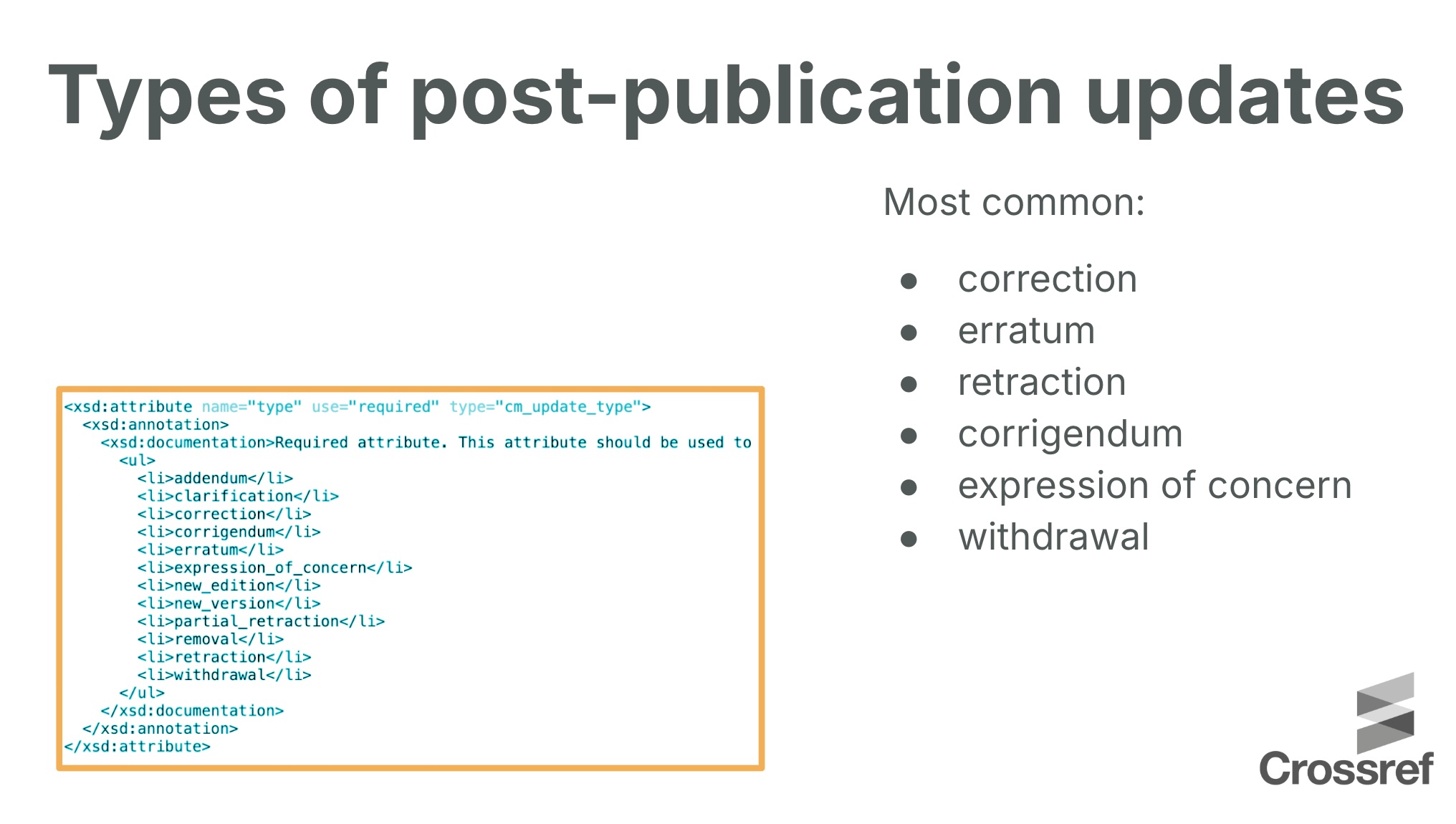
Numerous types of post-publication updates are supported by our schema and the most common ones are correction, erratum, retraction, withdrawal, corrigendum, expression of concern, and withdrawal. There are multiple options for sending these through: if you are comfortable with writing XML files, you can submit updates via XML deposit.
Although updates are registered in the Crossmark part of the schema, you do not need to be a Crossmark user to deposit your updates. We have several examples of how to register updates in our documentation that you can refer to. These include examples on how to link retraction or correction notices with the original item.
The web deposit form, which is one of our helper tools for content registration, can also be used for depositing updates. However, via this method you will need to re-enter and submit all the metadata for your record, not just the metadata related to the update.
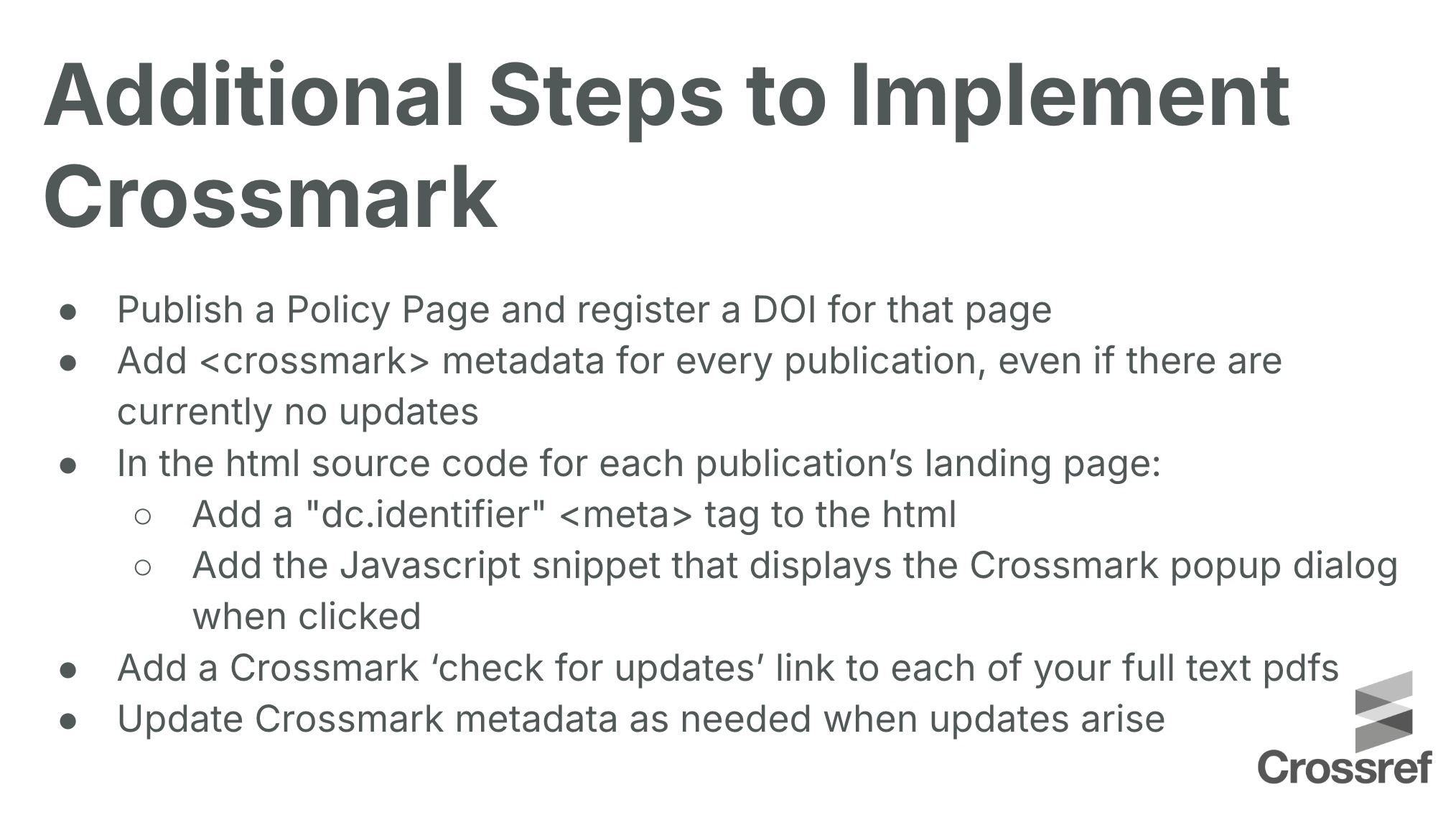
Shayn also touched on the Crossmark service. We are aware that this service has been technically challenging for our members to implement but as mentioned previously, you do not need to be a Crossmark user to deposit metadata on post publication updates. The main benefit of implementing Crossmark is that it helps to surface information about post-publication updates for readers in a consistent manner, even if they are accessing PDFs of publications away from the publisher’s website. Those interested in implementing the service need to publish a Crossmark policy page and register a DOI for it.
You can now also use our newest helper tool, the Metadata Manager to register post-publication updates for your journal content. To do this, choose the “post-publication update” option in the Metadata Manager and then fill it out with metadata of the update notice and the DOI of the journal content that is being updated. This might be a suitable option for those of you who are using OJS for sending your metadata to Crossref.
The recording and slides from this webinar can be accessed here.
Questions from the community
We had a very engaged audience for these webinars who had a lot of questions for our speakers. We thought it might be helpful to share the answers to some of them here:
How do I register my content?
You need to join Crossref as a member to register your objects with us (those could be journal articles, book chapters, dissertations, conference proceedings, datasets, grants, and more). Once you join – you will receive a DOI prefix. You can combine this DOI prefix with a suffix of your choice to create a DOI. Content registration enables you to register the DOI and deposit or update the metadata associated with the DOI record. The metadata about your content is stored with us as XML. If you are comfortable with writing XML, you can send us your XML files directly. But if you are not comfortable with that, you can use any one of our three helper tools. You can take a look at our quick guide for choosing your content registration method to learn more.
How to get a DOI for a journal published by a not-for-profit society?
The process for membership remains the same for everyone: simply apply here to join Crossref.
What is the use of XML files?
All of the metadata that is deposited with Crossref is submitted as XML. You can either submit the XML files yourself directly or you can use one of the helper tools to enter your metadata, which is then converted into XML and deposited with Crossref for you.
Has Crossref come across spam DOIs that mimic Crossref DOIs?
Take a look at this ticket of the month that my colleague from the member support team, Collin Knopp-Schwyn put together, on how to identify strings that look like DOIs but are just a hyperlink.
In many disciplines, authors frequently cite scientifically legitimate sources that do not have DOIs, such as institutional reports, public policy documents, and technical standards. Although these are valid and essential from a scholarly perspective, their citations are not incorporated into Crossref's citation linking. Is Crossref planning any future developments to better recognise these legitimate non-DOI references?
It is correct that not all references may have a DOI but it is still important to include such references in your metadata record. Our system regularly checks to see if a DOI has been registered for the cited item and if so, matches the reference to the DOI. Registering these references also means downstream systems that use Crossref metadata can ingest these references and use them for any citation linking they may be performing.
What is Crossmark and how is it connected or integrated with Crossref services?
Crossmark provides a way for readers to consistently discover the status of a research output, along with additional metadata related to the editorial process. You do not need to implement the full Crossmark service to deliver post publication update metadata. If you are interested in using the service, more information on how to participate is available in our documentation.
What are the best practices to report retractions in DOI metadata?
Take a look at this ticket of the month that my colleague from the technical support team, Kathleen Luschek, wrote, detailing why retractions are important, how to register them, and how to retrieve them.
Can you indicate an update to an article via Crossmark for a small correction that might not warrant a Correction?
When a change is made to a document without issuing a separate update or correction, it is called an in-situ update. In-situ updates are not recommended because they can obscure the scholarly record. However, sometimes members might need to support such updates and we have documentation available on how to do this.
Is there a mechanism that allows integrity-related events to be linked when they occur within the same scholarly context (for example at the level of a publication or a journal)?
When a registered item is updated, the update is captured in the item’s metadata. If there are a series of updates, they are also captured in the item’s metadata. All of this metadata is openly available via Crossref’s APIs. Anyone in the community can then use this metadata to analyse it at a scale that they are interested in, for example at a journal or publication level.
Does Crossref make any effort to get organizations into ROR?
Anybody can submit a request for getting an organisation added to ROR via this form. The ROR team then reviews the request based on their scope and criteria for inclusion.
We hope that those of you who were able to join one or more of the webinars found the information valuable and useful in your journey as a Crossref member. If you have any feedback, questions, or simply suggestions for other relevant topics that you would like to hear more about, I encourage you to post your thoughts on our community forum.